

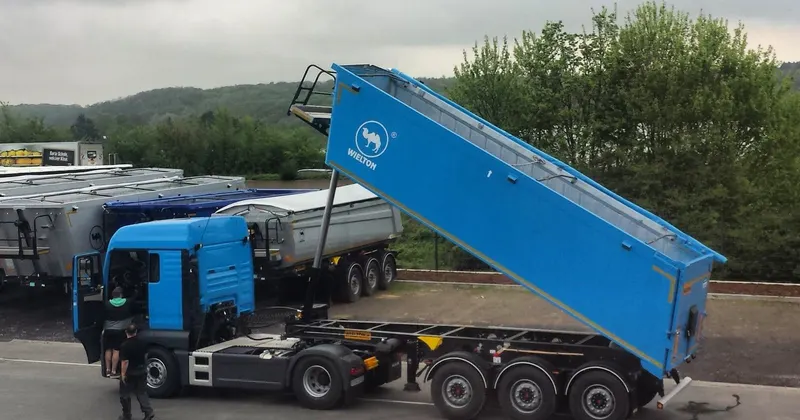
When a lorry leaves your site carrying more weight than it is allowed, the problem is not only the haulier's. Spanish transport law also holds liable whoever loads and whoever dispatches the goods, unless they can show that the excess is not attributable to them. Because the loading site is the one with the weighbridge, it is also the one best placed to prevent it. This article summarises which maximum weights apply, who is liable and how to organise departures so that no lorry leaves overloaded.
Where the limits are set
The maximum weights for vehicles on public roads are set out in Annex IX of the Reglamento General de Vehículos (Spain's General Vehicle Regulations), approved by Real Decreto 2822/1998 (Royal Decree 2822/1998). Section 2 contains two tables: one with the maximum weights per axle and another with the maximum authorised weights for each type of vehicle or combination. These figures were recently amended; according to the note accompanying the table, the change came into force on 23/10/2025 (on 23/01/2026 for tanker vehicles).
In addition, the Ley 16/1987, de Ordenación de los Transportes Terrestres (Spanish Land Transport Act 16/1987) states in Article 95.1 that both the general limits and the specific ones shown in the vehicle's registration certificate and documentation must be respected. If the documentation of a particular lorry shows a lower weight than the general limit, the figure in its documentation prevails.
The most common maximum authorised weights
According to table 2 of section 2 of Annex IX, in its current wording:
| Vehicle or combination | Maximum authorised weight |
|---|---|
| 2-axle rigid lorry | 18 t |
| 3-axle rigid lorry | 25 t (26 t under certain tyre and suspension conditions) |
| 4-axle rigid lorry | 31 t (32 t under certain conditions) |
| 4-axle articulated lorry | 36 t (38 t in some cases) |
| Articulated lorry with 5 or more axles | 44 t |
| Drawbar combination with 5 or more axles: 2-axle motor vehicle and 3-axle trailer | 42 t |
| Drawbar combination with 5 or more axles: 3-axle motor vehicle and 2- or 3-axle trailer | 44 t |
The table includes notes with exceptions: increases for alternative-fuel or zero-emission vehicles, for intermodal transport and for round timber transport on specific routes, as well as for European modular combinations, which have their own regime. If any of these cases affects you, read the full note in the BOE (Spain's Official State Gazette) before applying it.
Don't just look at the total weight. Table 1 also sets the maximum weight per axle, and a lorry can be within its total weight but have an overloaded axle if the load is badly distributed.
Who is liable if the lorry is overloaded
Ley 16/1987 regulates infringements for excess weight in Articles 140.23 (very serious), 141.2 (serious) and 142.2 (minor), and sets out who is liable:
- Excess over the maximum total weight: the haulier, the loader, the dispatcher and the intermediary involved are liable, except for whoever proves that the excess is not attributable to them.
- Excess over the maximum weight per axle: whoever stowed the load, or under whose instructions it was stowed, is liable.
The seriousness depends on the percentage of excess. For vehicles with a maximum authorised weight of more than 12 tonnes, which are the usual ones at a loading site, the thresholds on total weight are:
| Excess over the maximum total weight | Infringement |
|---|---|
| More than 2.5% and less than 10% | Minor (Article 142.2) |
| From 10% to less than 20% | Serious (Article 141.2) |
| 20% or more | Very serious (Article 140.23) |
For a 44-tonne articulated lorry, 2.5% is 1,100 kilos. The margin is narrow. The amounts of the penalties are in Article 143 of the same act and may change; check them in the current text.
How to prevent overloading from the loading site
- Know the maximum weight of each vehicle. The one in its documentation, not the one the driver remembers. For your regular lorries, keep it on record.
- Work out how much it can carry. Maximum weight minus actual tare. With an up-to-date tare you know how many kilos of load fit before you start loading.
- Weigh before it leaves. The gross weight given by the weighbridge is the figure that protects you. If it exceeds the limit, the excess is unloaded before the delivery note is printed.
- Watch how the load is distributed. A lorry with the load shifted towards the front or the back can overload an axle even if the total is fine.
- Take the material into account. With materials that absorb water, such as some aggregates, soils or biomass, the same volume weighs more in the rain.
- Keep a record. The delivery note with the weight from a verified weighbridge is proof that the lorry left within the limit.
- Train whoever loads. The loader operator needs to know the maximum load of each vehicle before starting.
Situations that often end in overloading
- Loading "by eye" a lorry that is not the usual one, using another, higher-capacity lorry as a reference.
- Filling the last gap to make the most of the trip.
- Using an old tare, or one from another semi-trailer, to calculate the load.
- Letting the lorry leave without going over the weighbridge again after adding load.
- Assuming the haulier already knows their limit.
Departure weight in CargoGest
CargoGest reads the gross weight, tare and net weight directly from the weighbridge and puts them on the delivery note without any typing. The lorry is identified by its number plate and the program remembers its tare, its haulier and its driver, so the operator sees the real gross weight before printing the delivery note and can correct the load if needed. The delivery note also records the vehicle and trailer, the driver and the haulier.
If you run your own fleet, CargoGest also stores your vehicles, their drivers and the expiry dates for MOT-equivalent ITV inspection, insurance, transport card and tachograph. Find out more in weighbridge software and fleet management.